
How Operating Discipline Replaces Features as the New Competitive Advantage in the AI Age
- Gandhinath Swaminathan

- Aug 25, 2025
- 7 min read
In today's landscape, launches of new AI features and tightening margins collide. Chasing features alone won't cut it. The true source of advantage lies in the repeatable, purpose-driven processes that turn innovation into customer impact.

The Diagnosis: The Unstoppable Force of Commoditization
AI and cloud tools have commoditized data, models, even expert know-how. Every startup can spin up a prototype; every competitor can copy a dashboard. When proprietary assets erode, the only sustainable edge is in how you deliver—your unique operating model. The strategic focus is now being forced to move beyond the product itself to the underlying operational and organizational capabilities that enable consistent, superior delivery.
The Allure of the 'Feature Race': A Strategic Trap
In a market where features are rapidly commoditized, many companies fall into a dangerous strategic trap: a reactive, feature-centric arms race. This approach is a hallmark of what Richard Rumelt calls "bad strategy," which is marked by a "failure to face the challenge" and "mistaking goals for strategy." Companies that engage in this race are responding to symptoms rather than addressing the root cause—the absence of a durable, operational moat.
I saw this first-hand with my client in a stealth industry. Their model is simple: buy raw data, clean and transform it, then sell insights at a premium. They moved fast, built solid adoption and led in the industry. Competitors started emerging, undercut prices and clean-and-sell business model lost its edge. Customers found free or cheaper alternatives. They churned.
What will save the winners? You should ask "Why do customers stick with us even when data is free or cheap elsewhere?" Re-engineering their internal processes to tailor data streams, improve insights quality and help customers uncover unseen value with the insights will reinforce their service as the real differentiator.
For any data-driven business today, the focus can't be "more data". It must be "what about our way of working makes clients pay for our know-how, not just our data feeds".
"If you fail to identify and analyze the obstacles, you don't have a strategy. Instead, you have either a stretch goal, a budget, or a list of things you wish would happen." - Richard Rumelt
The Coherent Core of Strategy
Richard Rumelt’s framework provides a crucial lens for moving beyond the pitfalls of bad strategy. A good strategy, he argues, is not a list of goals or a grand vision. It is a well-structured argument that supports a coherent plan of action, built upon what he calls "the kernel." This kernel consists of three interdependent parts:

Diagnosis | A great deal of strategy work is trying to figure out what is going on. Not just deciding what to do, but the more fundamental problem of comprehending the situation. This requires a clear, honest assessment of the situation, defining the nature of the challenge and simplifying complexity to focus on what is truly important. |
|---|---|
A Guiding Policy | The guiding policy outlines an overall approach for overcoming the obstacles highlighted by the diagnosis. It is 'guiding' because it channels action in certain directions without defining exactly what shall be done. It must be designed to create leverage or advantage, multiplying the effectiveness of resources. |
Coherent Actions | A strategy cannot be "all things to all people," and therefore requires acknowledging the necessity of sacrifices. The actions that implement the guiding policy must be coordinated and "build upon one another, focusing organizational energy. |
The Amazon Blueprint: A Study in Strategic Coherence
Amazon provides a definitive case study in how to build a durable, unassailable moat through operational discipline. The company’s famous "Day 1" culture is not merely a slogan but a deeply ingrained operating model that centers everything around the customer. The practical application of this discipline is enabled by what Bezos terms "mechanisms."
"Good intentions never work, you need good mechanisms to make anything happen." - Jeff Bezos
A mechanism is a complete, repeatable, and scalable process that replaces human "good intentions" with a virtuous cycle of action, adoption, and inspection.
The Deeper Parallel: Mechanisms as a Company's Dharma
The concept of a mechanism extends beyond a mere business process; it can be seen as the physical expression of a company's purpose. The challenge for a founder is to articulate and institutionalize their unique "operating thumbprint"—the distinctive way they work and think—so that it outlives their tenure. In essence, it is the process of translating a personal "dharma," a deeply felt purpose or authentic way of being, into a collective, repeatable practice. A company, like an individual, has its own unique dharma, a specific way it must work to achieve its potential and create value.
The founder’s "dharma" often remains their own, not the company's, which is why so many companies lose their edge when the founder steps away. The genius of Jeff Bezos was in mastering this transition. He engineered mechanisms like the PR/FAQ, last-mile delivery protocols, and single-threaded leadership not just as tools, but as an institutional articulation of Amazon's customer-obsessed "Day 1" dharma. He found a way to externalize his operating genius and embed it into a system that thousands of employees could embrace.
This view of a business reveals a different kind of strategic thinking where the most valuable asset is the process itself, the way you work, because it is the hardest to replicate. This is a profound shift.
"If you bring forth what is within you it will save you. If you do not, it will destroy you." - Stephen Cope in 'The Great Work of Your Life"
A company's survival, therefore, is tied to its ability to express its true nature—its dharma—through its operations.
From Barbarian to Synergist: The Leadership Journey
The corporate life cycle, as described as described by author Lawrence M. Miller in his book 'Barbarians to Bureaucrats: Corporate Life Cycle Strategies', provides a critical perspective on the dangers of a growth-at-all-costs mindset.
The "Prophet," a visionary founder, gives birth to the organization
The "Barbarian," an aggressive, decisive leader, drives its early conquest and rapid growth.
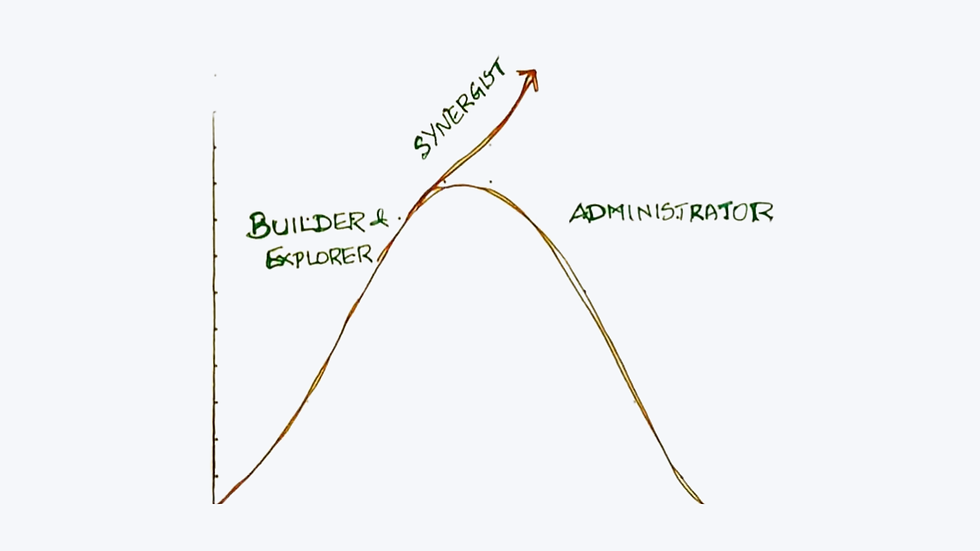
While essential in the beginning, this style of leadership can become a liability as the company matures. Only the Synergist unites creativity with discipline, aligning every function to a clear purpose.
Key Shift: Cultivate a Synergist mindset by embedding processes that reflect your company’s “operating thumbprint”—the unique way you achieve customer value
From Visionary Success to Bureaucratic Stall: A Cautionary Path
I worked for a computer-vision firm in Seattle area. The company began as a Prophet's dream. Their founder's breakthroughs drew venture funding and a market lead. The CEO, doubled down on innovation—hiring PhD researchers, expanding R&D labs, and chasing every benchmark.
That phase delivered rapid proof points but didn't translate to faster growth. Revenues crept up, but margins lagged. In response, the board installed Administrators. Budgets shifted to EBITDA targets, Kubernetes operators, and cloud-cost strictures. Customer success teams faded into the background. Innovation ran on autopilot toward internal metrics instead of real user outcomes.
This arc—from Prophet success to Barbarian zeal to bureaucratic control—missed the Synergist phase. A true Synergist leadership style balances visionary leaps with disciplined delivery, investing equally in the innovators and the people who turn innovation into value. Without that balance, even the brightest breakthroughs can stall beneath layers of red tape.
Risks of an Operational-First Business Model
The journey from a "Barbarian" focused on pure conquest to a "Synergist" who can balance creativity with order is the central challenge of corporate maturity. This transition is not merely a change in tactics; it is a fundamental choice to build a new operating model based on disciplined, institutionalized processes. When this shift is executed successfully, it offers significant advantages, creating an unassailable moat that competitors cannot breach. However, it also presents a profound risk: the very systems designed to create order can, if mismanaged, lead to the wasteful, stifling bureaucracy that a "Synergist" is meant to prevent.
The most significant risk is the potential for stifling innovation. An over-emphasis on process and discipline can inadvertently discourage the bold, "Prophet"-led leaps of creativity that are essential for long-term growth. The challenge for the "Synergist" leader is to strike a delicate balance between order and creativity, ensuring that the mechanisms of control do not become an obstacle to genuine innovation.
Concrete, Small Bets You Can Try Today

Here are three concrete, small experiments you can start with today.
Problem to Solve | Action to Take | Expected Outcome | |
|---|---|---|---|
The Information Gap | Leaders are guessing at customer needs, which leads to churn and reactive decisions. | Create a single, simple dashboard that aggregates customer feedback and sentiment from support tickets, social media, and survey responses. Move from guessing to knowing. | A clear summary of customer engagement. A single place for the entire team to see what is working and what is causing friction. |
The Usage Trap | The team is focused on product usage metrics (e.g., clicks, logins) but not whether customers are achieving their real-world goals. | Don't ask "how often do you use our product?" Ask "What did you accomplish with our product?" Talk to customers and have them tell a story about getting a "job" done. Understand their full ecosystem of tools. | A deep understanding of how your product delivers real value. A strategic shift from being a tool to being an essential part of a solution. |
The Meeting Chaos | Meetings are filled with updates and a "my team's metric" mentality. There is no shared direction or purpose. | Define one single North Star Metric (NSM) that connects customer value directly to business growth. Every meeting should start with this metric. | A shared language and a clear direction for every person on the team. A mechanism for eliminating wasteful work and ensuring everyone is pulling in the same direction. |
How We Partner With You
The shift from a startup to a mature, enduring company is not about implementing a few new tactics—it's the coherence and intelligence of your operating model. The shift from a reactive, feature-centric approach to a disciplined, operational-first strategy is a deliberate choice to build a new foundation for sustainable growth. It's about designing a company that operates on insight, not instinct, and institutionalizing a new way of working where processes are a source of power, not a bureaucratic burden.
Minimalist Innovation helps you re-engineer how you work. We diagnose the core challenges, focus on what truly matters, and integrate smart, repeatable mechanisms into your existing systems. We help you learn and adapt, building a transformed operating model that sustains your success.


Comments