
Agentic mesh for Analytics: Stop moving data. Start asking questions.
- Gandhinath Swaminathan

- Nov 3, 2025
- 3 min read
Why Your Data Team Can't Answer Your Most Important Questions
You acquired a company nine months ago. You still can't get a single view of your customer. Your board asks for a true profitability report across all divisions, and your team returns with three different numbers and a list of excuses.
You've spent millions on data warehouses and analytics talent. Yet every critical question that crosses business lines becomes a six-week research project.
The problem is not your data or your people. The problem is you are paying a hidden "translation tax" on every single question.
That is the promise of an Agentic Mesh. It's an intelligence layer that automates the expensive translation work that currently slows your business to a crawl, allowing you to ask, in plain English: "What is our true customer acquisition cost by channel across all our acquired companies?"—and get a single, verified answer in minutes.

The Architectural Blueprint for Trustworthy Answers
Getting to this point isn't magic; it's architecture. For years, we organized data into clean, separate kitchens—the Data Mesh philosophy. But we never built the restaurant. An Agentic Mesh builds the restaurant by connecting these kitchens with a new layer of intelligence. This requires a blueprint built on three foundational shifts in thinking.
The Foundation: Acknowledge Reality with Domain-Driven Design (DDD): First, accept that domains define reality differently. A "customer" in Sales is not the same as a "customer" in Finance. Instead of forcing a costly, brittle integration, DDD provides the architectural framework for these contexts to coexist.
The Structure: Build with Reliable Assets, Not Brittle Pipelines: Next, treat data and analytics like software (i.e. data products and analytics products). With Asset-Based Engineering (using tools like dbt and Dagster), data & analytics becomes a versioned, testable asset with clear lineage—not the messy exhaust of a fragile script. This gives AI agents a stable foundation, ensuring they work with certified products, not questionable data.
The Language: Create a Shared Dictionary with a Semantic Layer: Finally, agree on what things mean. A Semantic Layer, using engines like MetricFlow, acts as the definitive business dictionary for your agents. It standardizes metric calculations, ensuring every tool gets the same answer and eliminating the "three different numbers" problem for good.
These three pillars—DDD, Asset-Based Engineering, and a Semantic Layer—are the components of a modern architecture known as Headless Business Intelligence (Headless BI). This foundation decouples your data logic from the presentation tools and is the necessary launchpad for a trustworthy Agentic Mesh.
The Analytics Opportunity
With agentic mesh, you:
Ask the question in English
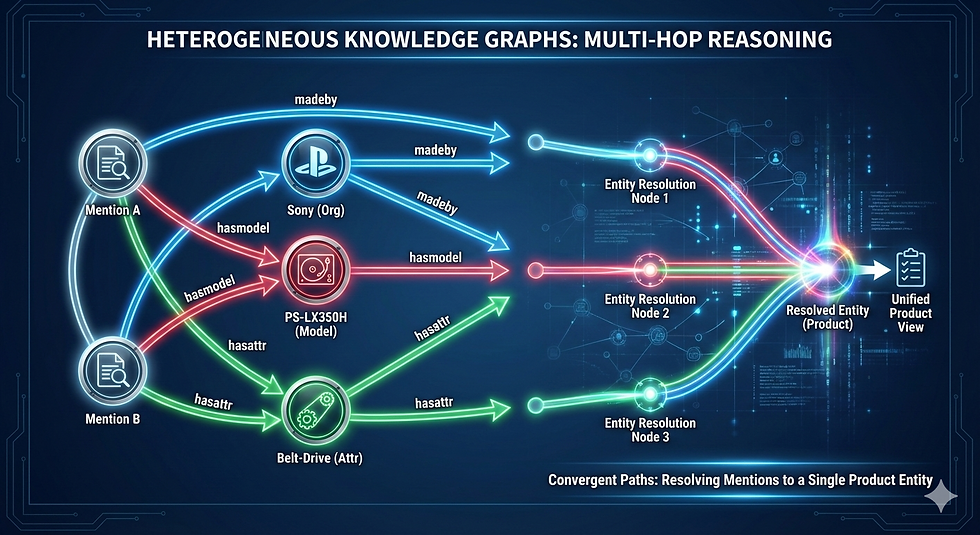
The agent identifies the required domains
The agent queries each system in its native language
The agent maps answers back to your question
The agent flags where definitions conflict ("Company A counts this as CAC, Company B doesn't")
You get the answer with confidence intervals, not false precision
The agent doesn't centralize data. It centralizes analytical authority—the ability to ask questions that matter.
The Honest Assessment
An Agentic Mesh for analytics isn't a magic fix. It requires the foundational work of clarifying your business domains, treating your data as an asset, and defining your core metrics. It won't solve bad data quality at the source, but it will make the cost of that bad data visible.
What it will do is dramatically accelerate the speed at which you can ask and answer critical business questions, turning your "translation tax" into an analytical dividend.
What Is Your Analytical Speed Limit Costing You?
For mid-market companies that have grown through acquisition, this is the most direct path to turning disconnected data assets into bottom-line answers. The question isn't whether you can afford to do this. The question is how long you can afford not to.
We specialize in building this foundation. Book a complimentary 30-minute diagnostic session. We will help you identify the single biggest "translation tax" in your organization and outline a plan to eliminate it.
References
Dehghani, Z. (2019). "Data Mesh: A Scalable Approach to Sharing, Accessing and Managing Data." Thoughtworks. https://martinfowler.com/articles/data-mesh.html
Dehghani, Z. (2021). Data Mesh: Delivering Data-Driven Value at Scale. O'Reilly Media.
Abel G., Indika K., Stefan D. (2024). "Data mesh: A systematic gray literature review." Academic research synthesizing data mesh principles and implementations.
Dagster documentation: Software-defined assets and asset orchestration. https://docs.dagster.io/concepts/assets/software-defined-assets
dbt Labs (2024). "dbt Semantic Layer and MetricFlow." Technical documentation on semantic model definitions and metric orchestration.
dbt Labs (2024). "How the dbt Semantic Layer works with MetricFlow." Architecture and integration patterns for semantic models.
Rissaki, A., Fountalis, I., Vasiloglou, N., & Gatterbauer, W. (2024). "Towards Agentic Schema Refinement." Research on semantic layers for agent-based database interaction and schema understanding.

Comments